In the Paris flats where we're called out for a first German cockroach infestation, the same question always comes up: "but where on earth did they come from?" When the building is clean, the neighbours report nothing and the service ducts are tidy, the answer is usually more mundane than people expect: something came in through the front door.
A delivery box kept in a storeroom, a second-hand microwave, a grocery bag set down on the worktop, a suitcase back from a hotel. The German cockroach doesn't fly several streets over and doesn't walk across the city. It travels. And it travels inside the things we carry.
Inspecting what comes in takes two minutes on the landing. It's the most cost-effective preventive habit we know of, because it saves you a full treatment a few months later.
Why objects make such good vehicles
A female German cockroach carries her egg case — the ootheca — glued to her abdomen until it hatches. A single adult introduced into a warm kitchen, with water and crumbs within reach, is therefore enough to start a colony. That's why you can go from "I saw one" to "there are some behind the dishwasher" in a matter of weeks.
The problem items all share three features:
- Dark, dry crevices: the flutes of corrugated cardboard, the edges of polystyrene, the screws and mouldings of an appliance, the lining of a suitcase.
- A mild to warm temperature: a motor, a transformer, an electronics compartment.
- Jolt-free transport, which doesn't disturb the hidden insect.
Conversely, an object that is smooth, cold and handled outdoors makes a poor shelter. That's the whole logic behind an inspection: look for the hiding places rather than for the insect.
 Tightly stacked used and torn corrugated cardboard boxes, seen from the front
Cardboard: suspect number one
Corrugated cardboard is a cockroach's favourite material. Its fluting forms tunnels sized exactly for them, the starch glue is a food source, and it stays dry. A box that has spent a night in a convenience store's stockroom, a warehouse or a building's bin room can leave again inhabited.
The boxes to treat with the most caution:
- parcels left for several days in a concierge's lodge or a communal room;
- boxes picked up behind a food shop for a move;
- fast-food packaging and pizza boxes;
- multipacks of bottles and tray-packed tins;
- a shop's stockroom crates, especially when placed directly on the floor.
The habit to adopt
Unpack on the landing, in the courtyard or on a balcony whenever possible. Take out the contents, look inside the fluting along the open edges, then flatten the box and take it out straight away. An empty box should never spend the night in a kitchen, a cellar or a cupboard. For a storage area in regular use, clear plastic storage boxes with lids are a far better alternative to cardboard crates: no fluting, no starch, and you can see what's inside.
In shops, the same principle applies on a larger scale: goods received in a dedicated area, unboxing before storage, nothing on the floor. It's also what hygiene inspections check for.
Second-hand appliances and electronics
We've devoted a whole article to cockroaches in appliances and electronics: the base of a fridge, the circuit board of an oven, the bottom of a coffee machine. A second-hand appliance concentrates exactly those risks, plus the unknown history of the kitchen it came from.
The appliances to inspect first:
| Appliance | Where to look | Why |
|---|---|---|
| Microwave | Underside, rear vent grille, control panel | Residual heat, crumbs, loose screws |
| Coffee machine | Grounds container, base, heating compartment | Sugar, moisture, constant warmth |
| Mini oven, toaster | Crumb tray, underframe | Food permanently within reach |
| Fridge | Compressor, condensate tray, door seal | A warm spot and a water source in one |
| Internet router, console, screen | Vents, power supply, feet | Warm electronics that are never moved |
| Washing machine, dishwasher | Kickboard panel, pump, hoses | Permanent moisture |
How we check an appliance
Outside or in the entrance hall, appliance unplugged, placed on a light-coloured surface:
- Turn the appliance over and light up every recess. A narrow-beam torch reveals corners a ceiling light never reaches; a model with a tilting head helps for the underside of housings.
- Look for droppings before looking for the insect: tiny black specks, like ground pepper, sometimes smears on light-coloured plastics.
- Look for shed skins and oothecae: pale translucent casings, elongated brown capsules around 8 mm long, often stuck in a corner.
- Tap the casing and wait ten seconds: light and vibration flush out whatever is hiding.
- Remove anything that comes off without tools: crumb tray, grounds container, filter, kickboard. A small precision screwdriver set is enough for a microwave's back panel or a printer cover.
If you find droppings or an ootheca, the appliance doesn't come in. Either you give up on it, or you leave it outdoors or in an unheated garage, cleaned and monitored for several weeks, with a sticky trap placed underneath.
Traps of this kind are in fact the best verdict: a cockroach sticky trap slipped under the appliance for a week tells you what the eye missed. We explain how to read them in our article on cockroach monitoring traps.
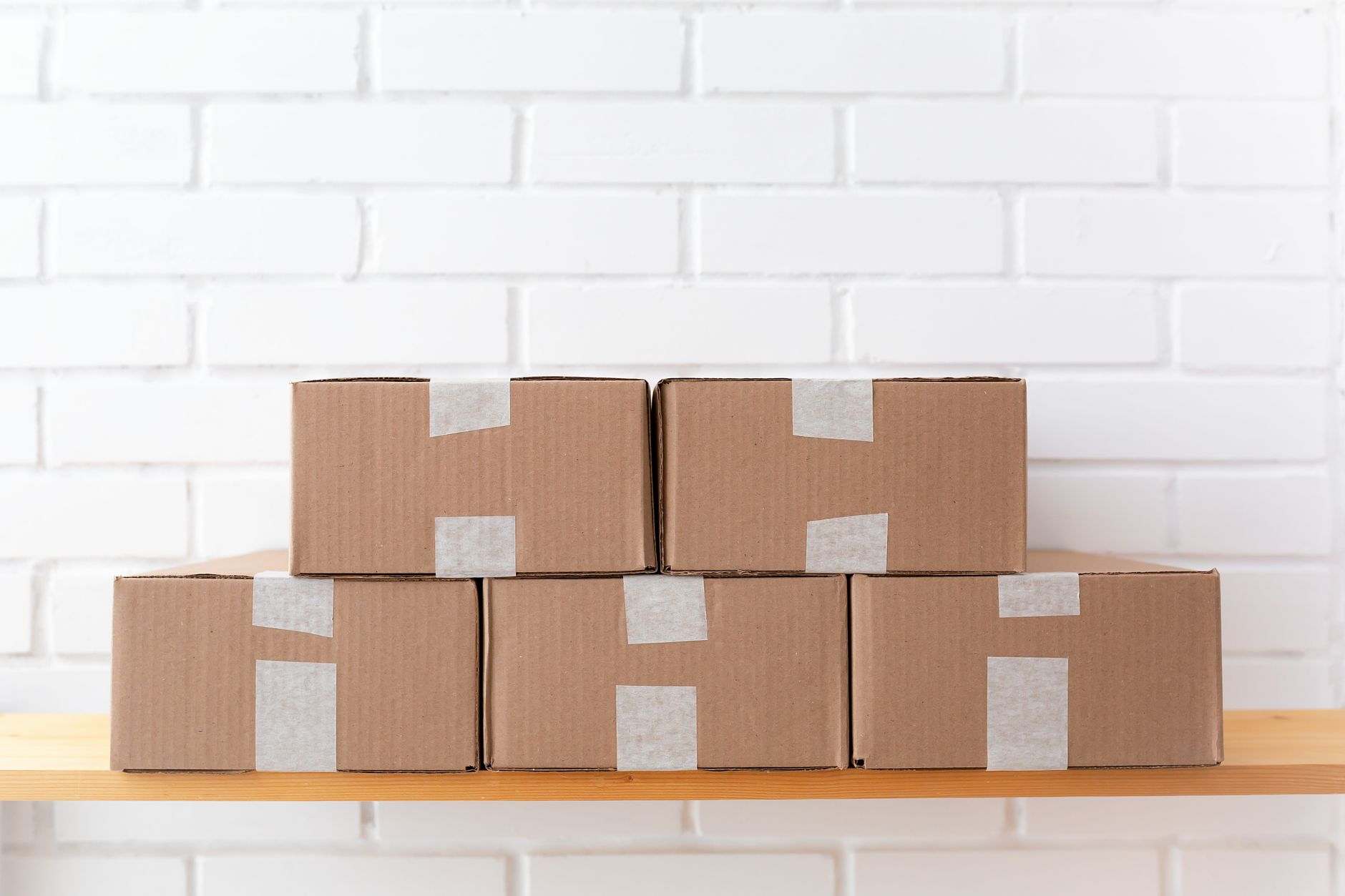 Five moving boxes taped shut, stacked on a wooden shelf in front of a white brick wall
Furniture, flea markets and car boot sales
Second-hand furniture is an in-between case. A solid wood table worries nobody; a chipboard kitchen unit, a drawer cabinet or a sideboard with a stapled plywood back, far more so.
What to check:
- the back of carcasses, between the panel and the frame;
- drawer runners and their cavities;
- damaged edges and dowel holes;
- the seals and silicone of a salvaged worktop;
- the inside of hollow metal legs.
A pass with a crevice-tool vacuum, then a damp cloth over every surface, deals with crumbs and droppings. Be careful with upholstered furniture, though: a second-hand sofa or mattress mainly carries a bed bug risk, a different subject that calls for its own protocol.
Suitcases, bags and coming home from a trip
The German cockroach also takes advantage of luggage, especially when you're back from a hotel, a holiday rental or a long stay with family. It doesn't settle into clothes the way a clothes moth does, but into the linings, side pockets, wheels and shell seams.
The simple protocol, to be done in the entrance hall or on a balcony:
- empty the suitcase completely, pockets included;
- put the laundry straight into the wash, with no stop on the bed or in the basket;
- vacuum the inside of the suitcase, then store it closed away from the kitchen, in a suitcase storage cover if it lives under a bed;
- throw out any packaging, sachets or leftover food brought back, outside the home.
For short-term rental hosts, this check is part of the turnover clean, just like the bedding. We go into this routine on our page dedicated to short-term rentals.
Grocery shopping
This is the least suspected route in. Dry goods travel on pallets, pass through stockrooms and can carry cockroaches as well as pantry moths. The packaging to watch includes bags of rice and pasta, cereal boxes, pet food sacks, tea cartons and shrink-wrapped water multipacks.
Three habits:
- check the outer carton before binning it, not just the product;
- transfer dry goods into airtight glass jars: this cuts off the food supply for cockroaches and moths alike;
- don't keep paper or plastic shopping bags piled up under the sink, the warmest and dampest spot there is.
 Used window air conditioners and household appliances piled up, rusty and dusty
Table: what comes in, what we check
| What comes in | Where to look | Decision if there's a sign |
|---|---|---|
| Parcels, boxes | Fluting along edges, base, corners | Unpack outside, remove the box immediately |
| Second-hand small appliance | Underside, vents, heating compartment | Don't bring it in, sticky trap for 7 days |
| Electronics (router, console) | Vents, power supply, feet | Dry air cleaning, monitoring |
| Second-hand kitchen unit | Back of carcass, runners, edges | Vacuum, clean, store separately |
| Suitcase, travel bag | Lining, pockets, wheels | Empty completely, wash laundry, vacuum |
| Dry groceries | Cartons, sachets, wrapping | Transfer to jars, packaging in the bin |
The mistakes that turn an incident into an infestation
A single cockroach isn't an infestation. But a single cockroach ignored, in a warm kitchen with a water source, becomes an infestation in two months.
The reflexes that make our job harder afterwards:
- Squashing the insect and moving on. A squashed female may have dropped her egg case elsewhere. The right reflex is to note the place and time, and set a trap.
- Spraying aerosol insecticide all over the kitchen. The repellent effect scatters the cockroaches towards service ducts, skirting boards and the neighbours, and it makes gel bait less attractive. It's the most common cause of infestations that spread after a "first DIY attempt".
- Keeping cardboard "just in case" on a balcony, in a cellar or on top of a cupboard.
- Waiting until you see several. Cockroaches are nocturnal and gregarious: seeing one in daylight already signals a population that is running out of room.
- Forgetting the bathroom. Once the kitchen has been cleaned, the colony shifts to the vanity unit and the water riser.
Regular upkeep of the risk areas also helps: worktop joints and skirting boards can be neatly resealed with a cartridge of sanitary silicone, and a monthly pass under the appliances is enough to remove the crumbs that feed a budding colony.
If an item has already brought cockroaches in
The right reflex is to contain, not disperse. In practical terms:
- Locate: set two or three sticky traps — under the suspect appliance, behind the fridge, under the sink — and collect them after seven days. Count the catches and note the stages (adults, juveniles).
- Treat: gel bait in micro-dots along their routes, combined if needed with a growth regulator, remains the reference treatment for the German cockroach. It works by ingestion and transfer, provided no insecticide has been sprayed beforehand.
- Check: re-reading the traps at two and then four weeks gives a real measure of the drop in activity.
- Prevent: seal up access points, get rid of cardboard, keep food in jars, and systematically inspect whatever comes in.
In a block of flats, remember to confirm the colony really is in your home. We explain how they move through vertical networks in our article on cockroaches in apartment buildings, and the details of our call-outs are set out on our pricing page. For a situation that is already established, you can book an appointment from the booking page.
On the public health side, ANSES (the French agency for food, environmental and occupational health safety) points out that cockroaches are a source of indoor allergens and food contamination, and recommends favouring targeted control methods over wide-dispersal aerosols. Santé publique France (the French public health agency) and the municipal hygiene and health services of Paris-region town halls say the same thing: hygiene, containment, localised professional treatment.
FAQ
Should I throw out a second-hand appliance where I found a cockroach?
Not necessarily, but it mustn't come into the kitchen as it is. Leave the appliance unplugged in a garage, an unheated cellar or on a sheltered balcony, clean every accessible compartment and place a sticky trap underneath it for at least two weeks. If no catches appear and no new droppings form, the appliance can be brought back in after a thorough clean.
If, on the other hand, you find an ootheca or several individuals of different sizes, the population is already established inside the appliance, and throwing it away costs less than treating your home.
I've seen just one cockroach in my kitchen — is that serious?
It doesn't mean your home is infested, but it deserves an immediate check rather than a shrug. German cockroaches are nocturnal and hide in groups; a visible individual, especially during the day, often indicates a population starting to run out of room, or an individual that has just arrived with an item.
The right response is to set monitoring traps for a week in the warm, damp spots, and to spray nothing in the meantime so as not to scatter the colony.
Do delivery boxes really bring cockroaches into Paris homes?
Yes — it's one of the routes in that we see most often, particularly in buildings where parcels sit for several days in a concierge's lodge, a communal room or a shop's stockroom. Corrugated cardboard offers galleries of just the right size, edible starch glue and a dry environment.
The risk becomes negligible as soon as parcels are opened outside the kitchen and empty boxes go out the same day. Keeping flattened boxes "just in case" in a cellar or a cupboard is exactly what to avoid.
We find the source before we treat.
Locate, treat, check, prevent: the Repère Protocol applied to your home or your business, anywhere in Île-de-France.